Introduction
The transport sector is entering a decisive phase of decarbonization. Alongside direct electrification, sustainable fuels — biofuels (produced from biomass) and e-fuels (synthetic fuels produced from renewable hydrogen and captured CO₂) — offer “drop-in” or alternative solutions capable of decarbonizing sectors where electrification remains difficult, such as aviation, maritime transport, or heavy-duty vehicles.
This overview presents the technical, economic, and regulatory landscape of these sectors, drawing on recent data from IFPEN, the IEA, European institutions, and concrete industrial case studies. Finally, the key skills required to support the development of this industry will be highlighted, along with the strategies to adopt.
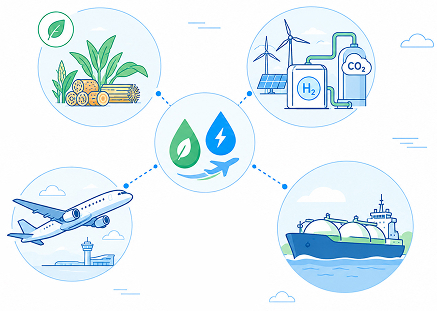
Definition of Biofuels and e-Fuels
Biofuels are liquid or gaseous fuels produced from biomass, meaning plant or animal resources, as well as waste and residues such as used cooking oils, animal fats, or lignocellulosic residues. Three generations of biofuels are generally distinguished:
- First generation: produced from sugars or starches and vegetable oils (FAME/EMAG) derived from crops such as corn, sugar beet, sugarcane, or rapeseed.
- Second generation: also known as advanced biofuels, produced from waste and residues originating for example from agriculture or forestry.
- Third generation: based on the use of microalgae as a feedstock for fuel production.
First-generation biofuels

Second-generation biofuels or advanced biofuels

Third-generation biofuels

E-fuels (or electrofuels) are synthetic fuels produced by combining renewable hydrogen, ideally generated through electrolysis powered by low-carbon electricity, with captured CO₂ from an industrial site or directly from the atmosphere.
Combining these elements makes it possible to produce synthetic hydrocarbons commonly referred to as e-fuels.
Existing Sustainable Fuels
Their Uses and Prospects
Among the existing sustainable fuels, first-generation biofuels are currently the most widely used. Their main area of use is road transport, as they are commonly available at fuel stations. In France, this is reflected in labels such as E10, E85, B7, and B10, which indicate the maximum percentage by volume of biofuels blended into the fuel.
At the global level, biofuel consumption amounts to around 107 Mtoe (million tonnes of oil equivalent), representing 4.8% of total fuel consumption. In 2023, the blending rate of biofuels in road gasoline and diesel reached 5.6%.
Among these biofuels are:
- First-generation bioethanol (1G), which is used as a substitute for gasoline. Around 56.7 Mtoe were consumed worldwide in 2023, representing an 8% increase compared with 2022.
- Biodiesel, which is used as a substitute for diesel fuel, reached approximately 50 Mtoe of consumption in 2023
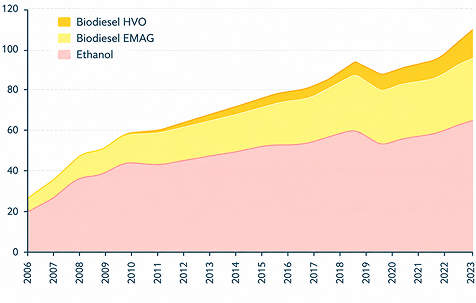
Fig. 2 – Changes in global biofuel consumption in road transport (Mtoe)
Source : IFPEN, based on S&P Global
Aviation (SAF)
Sustainable Aviation Fuels (SAF) can be produced from both biofuels and e-fuels. At the global level, their use is still very limited. However, the European Union, convinced of their potential to decarbonize air transport, adopted the ReFuelEU Aviation regulation.
This policy introduces a SAF blending mandate for all flights departing from European airports, requiring 2% SAF by 2025, 6% by 2030, and a gradual increase up to 70% by 2050, including a specific sub-quota for e-fuels starting in 2030.
This regulation will drive the increasing deployment of advanced biofuels and e-fuels from 2030 onwards, leading to a progressive increase in their use in the aviation sector.
Maritime
The maritime sector is currently testing and deploying several alternative fuels, including biodiesels (HVO, BtL), biomethanol, biomethane, and, in the longer term, e-fuels such as ammonia. Their use remains limited for now. However, the European Union has introduced FuelEU Maritime, which requires a progressive reduction in the greenhouse gas (GHG) intensity of the energy used on board ships, from -2% in 2025 to -80% by 2050. As a result, the use of these fuels is expected to increase over time.
Prospects
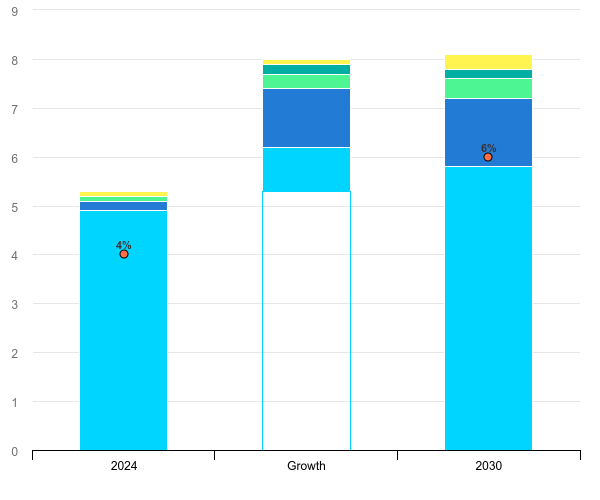
According to the International Energy Agency, renewable fuels are expected to experience sustained growth by 2030, driven by regulatory policies and increasing demand in the transport sector.
Beyond the favorable European regulatory framework established by ReFuelEU Aviation and FuelEU Maritime, other policies around the world are also encouraging the use of these alternatives, particularly in the United States, Brazil, Indonesia, and India. Ethanol, biodiesel, and SAF mandates, as well as financial incentives, explain the positive market outlook announced in these regions.
In the short term, biofuels remain dominant, while e-fuels are gradually emerging. In the medium term, e-fuels are expected to expand significantly, particularly from 2028–2030 onwards. Market analyses forecast annual market value growth of approximately 8% between 2025 and 2029.
Advantages and Disadvantages of
Sustainable Fuels
Advantages

- For advanced biofuels, substantial emission reductions are expected compared with their fossil equivalents, especially for production pathways based on waste and residues. However, the level of reduction may vary depending on the feedstock, production pathway, energy mix used during production, and associated logistics.
- For e-Fuels, the potential reduction in CO₂ emissions is estimated at around 80% to 90%. Achieving this level of reduction requires the use of very low-carbon electricity, typically generated from renewable sources or nuclear power. This potential can only be fully realized when the CO₂ used in the process is sourced from direct air capture or from unavoidable industrial emissions.


Disadvantages


Finally, e-Fuels remain costly and energy-intensive. These technologies are still relatively immature and require high capital expenditures (CAPEX) and operating costs (OPEX), as well as large amounts of renewable electricity. As a result, their production cost is currently estimated by the International Energy Agency to be four to six times higher than that of fossil kerosene.
Production: Principles, Products,
and Technology Maturity
Production pathways vary depending on both the feedstock and the target product, resulting in different levels of technological maturity.
First-generation ethanol (1G), FAME biodiesel, and biogas pathways are among the most mature technologies, with commercial-scale facilities operating for many years.
Similarly, HEFA/HVO pathways, used to produce renewable diesel and Sustainable Aviation Fuel (SAF), are considered mature in the short term, largely supported by the availability of used cooking oils and animal fats.
Several oil refineries have already been converted into biorefineries in Europe and North America. In France, notable examples include the conversion of the La Mède and Grandpuits refineries, with capacities of 500 kt/year and 230 kt/year of SAF, respectively.
More advanced pathways such as second-generation ethanol (2G), Biomass-to-Liquid (BtL), and Power-to-Liquid (PtL) are gradually developing through the deployment of demonstration plants and industrial pilot projects.
In particular, the number of e-SAF projects is growing rapidly, especially in Europe. According to the annual report of the International e-Fuels Observatory, 121 projects worldwide were identified in 2025.
However, only two projects had reached the Final Investment Decision (FID) stage. If all announced projects were completed, they would represent a global production capacity of 18,510 ktoe, with 32% of this capacity located in Europe.
Alternative fuels are also being considered for the maritime sector, particularly methanol and ammonia. Methanol can be produced from biomass or from CO₂ combined with hydrogen (CO₂/H₂).
Ammonia production relies on the well-established Haber–Bosch process, widely used in the fertilizer industry. This process requires low-carbon hydrogen production combined with nitrogen (N₂).
Numerous projects related to these two pathways have already been announced and are expected to emerge in the coming years.
Numerous other pathways exist but are not discussed here, as they remain at an early stage of technological development and are largely confined to research and development activities.
A Sector Under Construction:
Challenges and Skills Requirements
The production of next-generation biofuels and e-fuels relies on processes and equipment that are relatively close to those used in the oil and chemical industries, particularly for refining operations. However, several specific challenges arise, notably the use of different feedstocks and the integration of less mature technologies, such as water electrolysis or the Reverse Water–Gas Shift (RWGS) reaction process.
Beyond first-generation biofuels, new industrial projects can also rely on the conversion of existing refineries. This strategy allows traditional oil industry players to respond to evolving market demand while leveraging their existing infrastructure.
At the same time, other energy companies, whose core business may differ, as well as new companies positioning themselves as developers or operators, are investing in the construction of new industrial production units.
Key Skills to Support the Sector’s Growth
To accelerate and secure the development of this sector, both technical and cross-functional skills are essential.
- On the production side (producers, engineering companies, and investors), project managers, financial specialists, and developers must master the new production processes, their specific characteristics, associated risks, and the future cost structures of these technologies.
- Downstream in the value chain, stakeholders such as transport operators, logistics companies, equipment manufacturers, and engine manufacturers must anticipate the impact of new fuel molecules and adapt their technical practices and infrastructure accordingly.
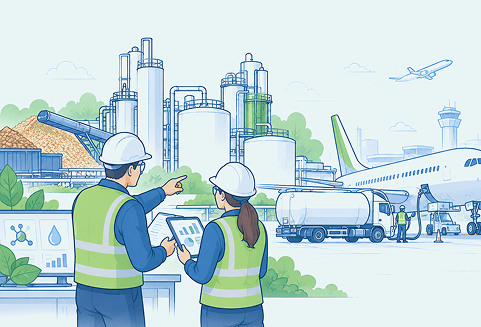
Evolving Skill Needs Throughout Project Phases
- During the development phase, operational needs become increasingly important. Future plant operators seek to optimize site organization and operating models, often drawing on petrochemical industry standards. It becomes essential to define appropriate organizational structures, competency frameworks, target recruitment profiles, and assessment tools supporting recruitment and workforce development plans. These tools will also help facilitate the retraining and transition of talent from other industrial sectors.
- During the production start-up phase, the training of teams — engineers, technicians, and operators — becomes crucial. Training programs must cover equipment, processes, operational procedures, maintenance, and HSE (Health, Safety, and Environment) aspects, while also integrating modules dedicated to new technologies. Building bridges between existing industries and the emerging sustainable fuel sector will be a key success factor. In this context, existing training programs will need to be adapted and updated to reflect the specificities of these new technologies.
Leveraging Historical Industrial Expertise
As any sector in a development phase, new technological building blocks are emerging, requiring teams working in the field to broaden their knowledge and skill sets. As a result, dedicated training programs are being developed.
For example, IFP Training offers highly technical programs covering low-carbon processes, decarbonized hydrogen production, and the CCUS value chain (Carbon Capture, Utilization and Storage). Existing economic project modeling tools also remain highly valuable, particularly when adapted through case studies tailored to these new projects. Experts in economics and management can develop custom case studies depending on the specific needs of each project. IFP Training has also developed dedicated programs covering the economics of hydrogen and CO₂ value chains.
Finally, this emerging sector can also rely on the skills and experience of the petrochemical industry, particularly for operational aspects. Support can therefore be provided in areas such as site organization, as well as the training of operations and maintenance teams, ensuring the successful start-up of production facilities.
Historically, IFP Training has delivered programs focused on operations and maintenance, which can be adapted according to the technological pathways selected. Depending on the learning objectives and participant profiles, comprehensive training pathways can be designed and implemented.
Key Takeaways
- Market growth is accelerating: in 2023, biofuels reached approximately 107 Mtoe, representing around 4.8% of global road transport fuels, with a 14% year-on-year increase.
- The European Union is setting the course through ambitious regulations, including ReFuelEU Aviation (SAF blending targets reaching 70% by 2050, with a dedicated e-fuels sub-target) and FuelEU Maritime (an 80% reduction in GHG intensity by 2050 on a well-to-wake basis).
- Producers need to understand these emerging production pathways and technologies in order to position themselves effectively and refine their strategic decisions. They can leverage extensive expertise from the refining, petrochemical, and chemical industries, much of which is transferable and can support the development of these low-carbon fuel value chains.
Going Further: A Selective Bibliography à la place de juste "Selected Bibliography"
-
IFP Energies Nouvelles – Biofuels Dashboard 2026 (updated 08/10/2026):
ifpenergiesnouvelles.fr. -
International Energy Agency (IEA) – Renewables 2025:
iea.org. - European Union regulatory framework:
easa.europa.eu, transport.ec.europa.eu, www.dnv.com, theicct.org -
Bpifrance – Big Média: educational dossier on biofuels, definitions and uses.
bigmedia.bpifrance.fr -
Industrial case studies: development of biorefineries and waste feedstock supply chains, including initiatives from TotalEnergies (feedstock agreements, hydrogen decarbonization strategies).
totalenergies.com, www.20minutes.fr, lefigaro.fr -
E-fuels technologies: definitions and Power-to-Liquid (PtL) pathways analyzed by organizations such as Wood Mackenzie and Airbus.
woodmac.com, airbus.com
About IFP Training
3 examples of recommended training programs
(inter-company / in-house, customizable by sector)
- Energy Products and Low-Carbon Processes: Discover the characteristics and processes for accessing key bio-based products and intermediates, including biofuels and e-fuels
- CCUS: Position the CCUS value chain within the current energy landscape and understand the core technologies associated with each link
- Overview of CO2 Economics: Understand carbon pricing mechanisms and regulations related to emissions limits around the world, identify their effects on the market, and assess the cost of the CCUS value chain

Contact us to discuss your needs and develop a training plan tailored to your technical teams (RD, testing, production)