Introduction
A long-standing pillar of the energy mix in many countries, such as France, nuclear energy is currently experiencing a resurgence of global interest driven by the climate emergency and the need for energy independence.
By providing a largely carbon-free baseload electricity supply, it is indispensable for supporting the massive electrification of end uses while ensuring grid stability.
Definition and Technologies
Nuclear energy is produced by the fission of heavy atoms (such as uranium-235), which releases intense heat. This heat is used to generate steam that drives a turbine coupled to a generator to produce electricity. Key technologies include:
- PWR (Pressurized Water Reactors): The most widely used technology worldwide, utilizing ordinary water as both a moderator and a coolant.
- EPR (Evolutionary Power Reactor): A third-generation reactor featuring enhanced passive and redundant safety systems.
- SMR (Small Modular Reactors): New-generation small modular reactors, designed to be mass-produced in factories and deployed flexibly.
Uses and Prospects
Advantages and Disadvantages
Advantages


Disadvantages


Operation and Maintenance
The nuclear industry relies on operational excellence. Maintaining the conventional plant (rotating machinery, steam turbines, centrifugal pumps) in operational condition is just as crucial as maintaining the nuclear plant. Vibration monitoring and predictive maintenance are key processes for ensuring availability and safety.
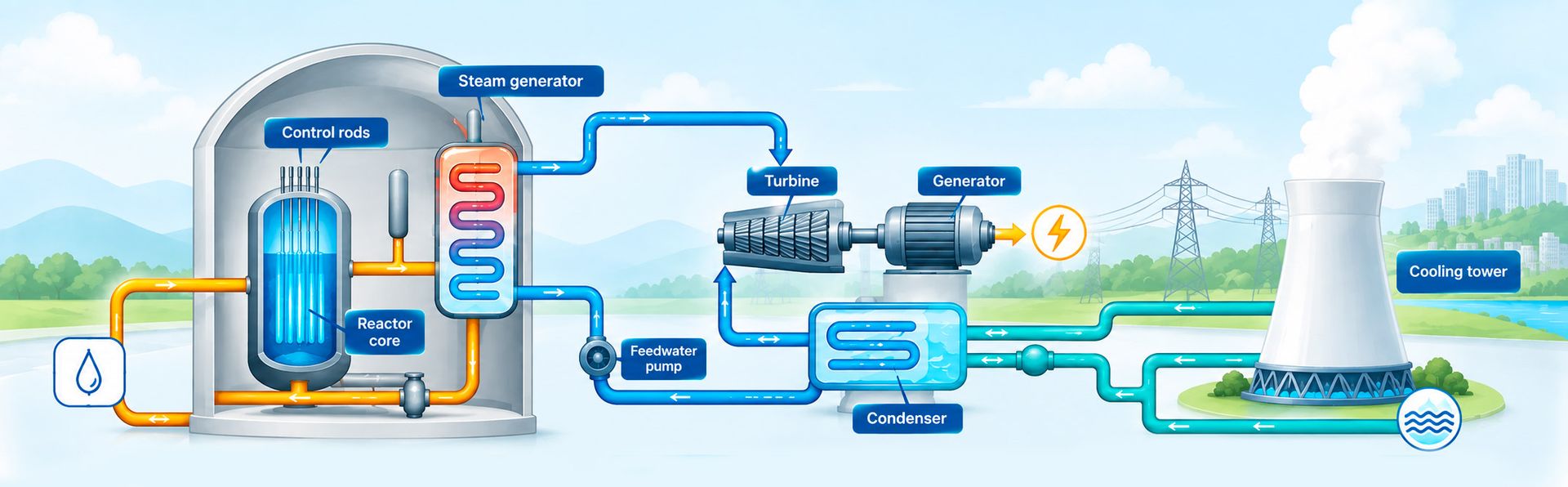
Primary system
nuclear fission in the reactor core heats pressurized water
Secondary circuit
the heat converts the water into steam to drive a turbine coupled to an alternator that generates electricity
cooling circuit
which condenses the steam using make-up water or cooling towers
Outside the reactor vessel itself, efficiency and safety depend on major industrial equipment, including turbomachinery, high-pressure feed pumps, pressurized piping systems, instrumentation, and automated control networks—all of which are found in heavy-duty energy processes such as those in the oil, gas, and chemical industries.
A Demanding Industry: Skills Needs
As part of the massive revival of the nuclear sector (the EPR2 program, the extension of the fleet’s lifespan through the Grand Carénage program, and the emergence of SMRs), the industry faces unprecedented, large-scale hiring needs—with a target of nearly 100,000 new hires by 2030—leading to a genuine shortage of skilled labor.
It is against this critical backdrop that IFP Training offers a training catalog rooted in engineering and process engineering, providing an essential cross-disciplinary technical foundation.
It delivers in-depth expertise in rotating equipment, boiler making, plant supervision, non-destructive testing, and industrial risk management. Through highly practical methods such as dynamic simulation, this training program serves as an ideal bridge to quickly retrain technicians and engineers from other heavy industries and accelerate their skill development for the nuclear sector.
About IFP Training
Drawing on our long-standing expertise in processes and operations, IFP Training supports the nuclear industry in meeting its specialized technical needs, particularly in the operation and maintenance of rotating machinery. Here are three examples of recommended training programs in this field:
-
Rotating Machinery Vibration Analysis: Assess the progression of mechanical defects (imbalances, bearings) in turbo-generator sets and pumps.
Access the programme: Training - Rotating Machinery Vibration Analysis | IFP Training -
Diagnostic and Maintenance of Centrifugal Pumps: Master the technology and critical operating conditions of industrial pumps. Delivered in French.
Access the programme: Formation - Diagnostic et maintenance des pompes centrifuges | IFP Training -
Operation, Maintenance, and Inspection of Rotating Machinery: Acquire the key skills related to mechanical operation and maintenance tasks to maximize reliability.
Access the programme: Training - Operation, Maintenance and Inspection of Rotating Machinery | IFP Training
We develop customized training programs for your teams, either on-site or at our training centers. Contact us for a tailored quote.

Contact us to discuss your needs and develop a training plan tailored to your technical teams (RD, testing, production)